Indie Seers: Ogre You Asshole’s elegant introspection

1081-ac-japan-beat-ogre-you-asshole-860x480

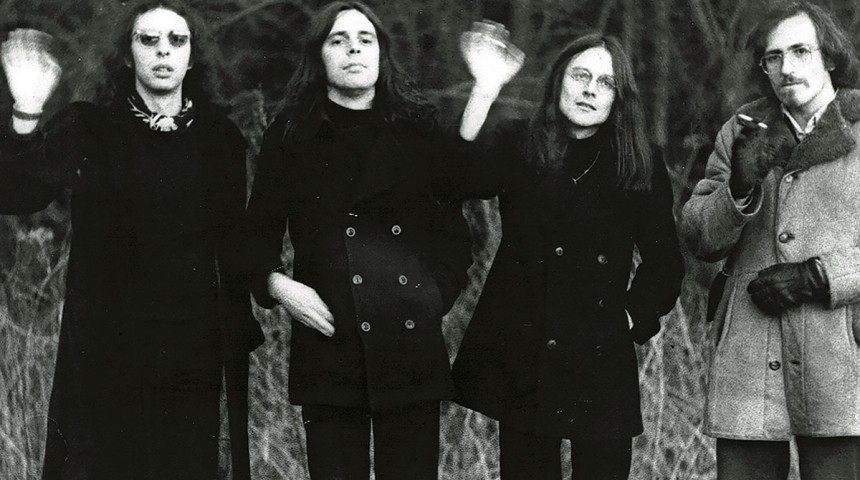
A sense of honeyed sadness suffuses Nagano indie rockers Ogre You Asshole’s new album Papercraft. “If you must put it into words,” frontman Manabu Deto says of the trilogy the disc completes, “the unifying theme of those three albums would be ‘someplace cozy and comfortable, yet miserable.’”

Deto is reluctant to comment further on any specific themes of the album’s songs but prodded on the matter, offers the following metaphor:  “Something that looks decent on the surface could be so shallow and flimsy when viewed from a different angle—like a stage prop in a play.” It’s a sentiment reflected in the cover of Papercraft, which depicts a Hollywood-style building façade: All surface and no depth.

Perhaps it’s the slower pace of country life or the distance from Tokyo’s commercial entertainment industry, but Ogre You Asshole’s sound impresses as more contemplative than that of many indie rock outfits in the capital.

All surface and no depth: The Papercraft cover depicts Hollywood-style building facade

Since forming a decade ago in Nagano, the band has stubbornly resisted the lures of the big city. The ability to step back and do something expansive and conceptual is important to its members. “Creative activities of artists change with the times,” Deto says, “even more so in the rapidly changing times we live in. In such a transitory world, in order for Ogre not to be affected by fast-changing trends and create a series of works with a strong unifying theme, we had an understanding between the band and our production team that it was necessary for us to take a few years making three albums so our listeners could gain an understanding of our work.”

Papercraft launches with “Someone’s Dream,” a noire outing that sounds like it could appear on a Wim Wenders or Quentin Tarantino soundtrack. The album then segues through the boogaloo beats of “Perfect Lovers in the Perfect City” to the laconic, slide guitar-driven title track.

Throughout, Deto’s singing and his bandmates, guitarist Kei Mabuchi, drummer Takashi Katsuura and bassist Takashi Shimizu’s playing are understated yet always unexpected. Listeners familiar with cult psych rock band Yura Yura Teikoku will detect a rich vein of quirky influences from leader Shintaro Sakamoto.

Deto cites Sakamoto’s “strong concepts,” and Papercraft was in fact produced by You Ishihara and engineered by Souichiro Nakamura, both of whom worked with Yura Yura Teikoku. The album’s analog recording approach and use of vintage instruments like the mellotron also impart a nostalgic acid rock atmosphere that gives it a certain kinship with Sakamoto’s work.

Ogre’s psych rock appeal has made the group a favorite touring partner of bands like Modest Mouse (whose bassist gave them their name from the film Revenge of the Nerds), Wolf Parade and Deerhunter. Live, the band stretches out on extended improvisational excursions that evoke Krautrock, another key influence.

But Ogre You Asshole aren’t trying to lead or follow any specific trend or pop music phenomenon. “For the past few years, I’ve been listening mainly to music of the ‘60s and ‘70s, so I don’t really know much about the current music scene,” Deto says.

“I thought bands such as Deerhunter, MGMT and Wolf Parade, with whom we performed in Japan, were all good. I recently heard Flying Lotus and Ariel Pink, and they were good too. But we don’t really know much about them and aren’t so interested in what’s happening in the Japanese band scene.”

Dec 27, 7pm. ¥3,600. Liquidroom, 3-16-6 Higashi, Shibuya-ku. Nearest station: Shibuya. http://meturl.com/ogrepapercraft


Ten Indispensable Albums
We asked Ogre You Asshole’s Manabu Deto to name ten albums he simply could not do without.

  1. Joe Meek, I Hear a New World
    Kei (Mabuchi/OYA’s guitarist) wrote a song that reminded me of this Joe Meek album, which we recorded for the Japanese Anime “Space Dandy.”
  2. Can, Tago Mago
    Back in our college days, a friend of mine used to play this album a lot. It brings back memories and so I guess this is my favorite of all Can albums.
  3. Modest Mouse, This Is a Long Drive for Someone With Nothing to Think About
    This is the album that I listened to most in my college days when we started our band. It’s different from the kind of music we play now as OYA, but I still think it sounds great.
  4. Todd Rungren, Something Anything?
    I like all of Todd Rungren’s albums, but particularly like this one. I guess this album shows what I think of as “mellow.”
  5. Arthur Russell, World of Echo
    It’s so soothing that I could just keep listening to it.
  6. Stereo Lab & Nurse With Would, Simple Headphone Mind
    I’ve been listening to Stereo Lab for quite some time, but I’ve just recently heard this album they made with a noise/industrial rock band called Nurse With Wound for the first time. I thought that they were doing the kind of minimal musical phrases we sought to create (on our new album Papercraft) already in the ‘90s.
  7. Terry Riley, A Rainbow Curved Air
    The thing I like about Terry Riley is that his music sounds inorganic, but if you keep listening to it, it gradually leads you to a trippy state.
  8. Yo La Tengo, And Then Nothing Turned Itself Inside­-Out
    The thing I like about Yo La Tengo is that just by listening to their album, I can tell that they truly love music.
  9. Throbbing Gristle, 20 Jazz Funk Greats
    In between albums “100 years passed” and “Papercraft”, OYA released an album called “Confidential” which we rearranged songs from our early days. We came up with the ideal of adding industrial rock elements like that of D.A.F. and Throbbing Gristle and it turned out quite interesting.
  10. Lou Reed, Transformer
    The first solo album by Lou Reed that I ever listened to was New York (released in 1989). I thought that I prefer the Velvet Underground over his solo works, but then when I started listening to his earlier solo albums released during the ‘70s, I came to like his solo works more.

Ken Tanaka: YouTube star smashes stereotypes

We tracked down Ken Tanaka, the Caucasian-Japanese star of numerous YouTube shorts parodying Asian stereotypes.

Tanaka says he was adopted by Japanese parents in the ’70s, and was only recently reunited with his long-lost twin brother, Californian actor/comedian David Ury. Despite their side-by-side appearances in videos seen by thousands, some still suspect they’re—ahem—the same person.

Why did your Japanese parents decide to adopt a Caucasian American?

In the mid-’70s, Japan had a big booming economy and it was popular for Japanese families to adopt American babies. Kind of like how American celebrities such as Madonna and Angelina Jolie adopt babies from other countries.

What was it like growing up as a white Japanese person in rural Shimane?

I lived in a very small village high in the mountains with a population of under one hundred people. Everybody had known me since I was a baby, so nobody treated me any differently than any other boy in my town. 

How is your search for your birth parents going?

It is a difficult journey, but I will never give up. 

What inspired you to begin making videos?

I met a person when I first came to Los Angeles who suggested that YouTube would be a great way for me to share my story. I had never heard of YouTube before and I had never made a video. But my friend had a camera; he showed me how to work it and how to upload videos. It’s been seven years now since my first video.

Tell us why Asian stereotypes make your videos funny.

You’re probably referring to our videos, “What Kind of Asian Are You?,” “But We’re Speaking Japanese,” and “Asian Stereotype Police.” These are all videos that question assumptions about race and identity. When we write these comedy sketches, we look for common but absurd situations that we think people will be able to identify with.

How does the response to your videos about Asian stereotypes differ in the West and Asia?

For “What Kind of Asian Are You?” we got a lot of comments from Caucasian people who were sure this could never happen in real life—and then a lot of comments from Asian people who said they experienced this kind of situation often. I think people in the West generally are more sensitive about these kinds of comedy videos.

What do you have in mind for your next video?

We just released a new video where David and I discuss Japanese jokes and David tells some jokes that I have heard from many Japanese language learners.

Tell us about your new book.

Earlier this year, my brother and I collaborated on a new book called Everybody Dies: A Children’s Book for Grown-Ups. It’s an illustrated picture book that can help grown-ups cope with the inevitable fate that awaits us all. It includes fun activities like “match the corpse to the cause of death” and a last will and testament that you can fill out. It’s fun for the whole family. 

More information on Ken Tanaka, his work and his books can be found at www.kentanakalovesyou.com

The Mornings: Post-hardcore trio explores new ideas

1077-ac-japan-beat-mornings1-e1415617215464

The Mornings are a band of ideas. It’s no coincidence they’ve named their brand-new album Idea Pattern.

But when Metropolis first speaks with them, it’s last winter and the trio is busy rehearsing at a friend’s Asagaya studio for a gig celebrating the band’s tenth anniversary.

“At first, we didn’t know what we were doing—we just did what we wanted. We were naive college students,” says singer/guitarist Junya Kishino. “We’d always wanted to do something original, but we didn’t have the ability to pull it off. I think our skills have finally reached the level where we can do what we want to.”

Emerging out of the post-hardcore scene, the band’s early material was intended to be cathartic. “On our first album, work stresses were a big theme,” Kishino continues. “I come from punk and hardcore, so there’s some of that influence in the first album. But on the second album, the ideas are more imagistic. I always think, if people listen to music with their eyes closed, what would come to mind? Then I write based on what that might be.”

The Mornings’ third album, Idea Pattern, builds on this impulse. The Tokyo band, which also includes keyboardist/vocalist Shimpei Watanabe and drummer “Kemono” (“beast”) Keika, was looking to create music that demands more of the listener.

“Compared to the last album, this one is not only catchier,” they say. “It’s also difficult to say exactly what kind of music it is.”

Listeners may recognize a bit of the thrashy blend of guitar rock and electronica that characterizes bands such as Japan’s Boom Boom Satellites. But The Mornings’ music has a headier quality—something akin to their heroes Radiohead—that makes it equally as suited to headphones as to the mosh pit.

“VSCOM,” for example, begins with Kraftwerk-era synth bloops before launching into Keika’s formidable drumming. Dub-ified vocals from Watanabe are chopped into fragments before Keika drops in with a singsongy, almost J-pop refrain. And then, without warning, it ends.

Idea Pattern by The Mornings

“From the first 11/8 meter sampler phrase, I aimed for something that sounds a bit like an electronic, kaleidoscopic version of the Matrixsoundtrack,” says main songwriter Watanabe. “The rhythm has abrupt changes and tricky drum and bass, but it’s not intended to sound tricky or make you feel uncomfortable. We put a lot of time into arranging this song. Especially in the last violent climax of the song, the previous parts all come together in an unexpected way.”

The Mornings turned to noted Japanese dubstep producer Goth-Trad to helm the production of Idea Pattern. “We had cosmic images in mind,” they say. “In order to bring out that atmosphere, we felt the only way to do it was to work with a cutting-edge electronic music producer.”

The band says it was the right choice. “It wasn’t only that Goth-Trad understood our intention and gave form to it, but also that he understood the potential of songs that even we ourselves didn’t have a sense of. He’s very detailed and makes good decisions; we got a sense of why he’s respected as a producer worldwide.”

With the band members holding down serious day jobs as copywriters, corporate planners and IT headhunters, The Mornings are a determined lot to stay together for ten years. What have they learned in a decade on Tokyo’s often soul-sucking “live house” scene?

“Most of the bands that started around the same time have broken up,” Watanabe says, laughing at the question. “I just turned 30, around the age when many give up. A lot of people make music for commercial success, and when that doesn’t happen they stop.

“For us now at 30—I have a kid and our drummer is also married—it will be harder for us to balance our lives, and there will be tradeoffs. If we’re going to sacrifice, then we want to make music that will go down in history in some way.

“You never know if you’re going to sell records, so you may as well do something special.”

Idea Pattern release party Nov 19, 7:30pm, ¥2,500. Shimokitazawa Shelter. Nearest station: Shimokitazawa.

http://themornings.biz

Mr. Porter “A Saturday with…Zim of Black Shadow”

Screen Shot 2014-11-13 at 8.48.26 PM

Film by Mr Antony Crook (Text by Dan Grunebaum)

They are Tokyo icons. Visit Yoyogi Park or the waterfront of Odaiba on a Saturday or Sunday and they’ll be there, rain or shine. Swivelling in leather get-ups to vintage rock blasted through portable sound systems, they’re Japan’s self-styled rockabillies.

Zim is the leader of Black Shadow, a well-known gang who dress up like 1950s rock’n’rollers. During the week, Zim is Mr Kinya Ueno and he holds down a regular nine-to-five job. But he prefers not to talk about his life Monday to Friday, for he is a man who is truly working for the weekend.

Black Shadow’s heyday was in the 1980s, when Japan experienced a retro-rock boom and American and British pop culture offered an irresistible lure of freedom to rebellious Japanese youths, who railed against a conservative society ruled by the proverb “the nail that sticks out gets hammered down”.

Zim left high school in the provinces as soon as he could and fled to Tokyo as a teenager, determined to become part of the scene. Like many who reject Japan’s corporate treadmill, his decision consigned him to a life on the margins.

But for a member of Black Shadow, being part of the gang was more than ample reward. Music and fashion provided more of a satisfying life than being one of Japan’s corporate salaryman drones ever could.

Heavily tattooed, clad in black leathers and with their “Regent” pompadour hairstyles blow-dried and styled to crazy heights, Black Shadows do what many Japanese can only dream of: express themselves. Extravagantly. Unabashedly.

Now these rock’n’rollers are growing old. Zim, now 45, has been in the gang for nearly 30 years. But teens today are into J-pop or electronic dance music. They have home-grown styles such as cosplay (dressing up in anime/ manga/ cartoon costumes) and don’t look to the West as much as Zim’s generation once did.

Still, as long as Zim can wax his Regent and shake his hips to the rock’n’roll beat, he’ll keep coming back each weekend to the place – and the people – that gave him his identity and set him apart from the mainstream; that made him and all the Black Shadows, in a word, different.

Rock in Opposition: European fest explores prog-rock’s potential in Japan

1075-to-do-list-rock-in-opposition-860x480

The original Rock in Opposition (RIO) took place on March 12, 1978 in London, England. It brought together European prog-rock bands united by their common unmarketability to major record labels, including such acts as England’s Henry Cow, Italy’s Stormy Six and Belgium’s Univers Zero.

Over 35 years later, the fest finally sets foot in Japan, chaired by Akiko Nagai. Head of Disk Union’s progressive rock section for seven years, Nagai also helms the Tutinoko label, on which some of the RIO musicians have released albums. Nagai sat with Metropolis to discuss how it all came about.

How did Rock in Opposition come to Japan?

It grew out of the first tour by RIO headliners Univers Zero. The core group of people behind the festival were involved in producing the tour. Then our release of the documentary DVD About Rock in Opposition sold well, showing there is a demand for this sort of event in Japan. We then negotiated with French RIO festival directors Michel Besset and Chris Cutler for the rights to the name. As it turned out, the name “Rock in Opposition” was already in the public domain. We then linked up with Smash West and the Tokyo Arts Council to put it together.

What are your hopes for Tokyo’s first Rock in Opposition?

We want to share the history of Rock in Opposition with many people—not only prog-rock fans but all people with open ears. We also want to bring together the worldwide rock scene with the Tokyo scene, in hopes that something new will emerge, and that it will provide a platform for avant-garde music in Japan. RIO is expensive to put on, and the tickets aren’t cheap, but we hope that if it’s successful one day we can put on a free concert.

What is the audience like for progressive rock in Japan?

Japan’s prog-rock market is large. Bands can fill large halls here. But there are a lot of young bands that borrow prog-rock’s forms, rhythm changes and instrumentation, but aren’t really progressive rock in the true sense of the term. We don’t want to host a nostalgia-fest. The artists on our lineup are forward-thinking—“progressive” in the true sense of the word. The music may be difficult, but we hope our audience will rise to the challenge.

Nov 15-16, 3pm, ¥14,000. Tsutaya O-East. Nearest station: Shibuya. Tel: 03-5458-4681.

www.rockinopposition-japan.com/index_en.html

Japan’s PR battle for U.S. hearts and minds

A Xinhua billboard in Times Square. Japanese companies are no longer as prominent as they used to be.

A Xinhua billboard in Times Square. Japanese companies are no longer as prominent as they used to be.

NEW YORK — It might not surprise anyone to learn that China’s state-owned broadcaster CCTV America more or less ignored Hong Kong’s democracy protestors, except to note police injuries by “aggressive” activists. Nor would Americans be shocked to read in China Daily — available for free in towns like Boston and Washington DC — that China has historical claims over the entire South China Sea.

But it’s more disappointing for we Americans with ties to Japan to learn that Japan’s theoretically independent NHK World has editorial guidelines forbidding any reference to the Senkaku/Diaoyu territorial issue as a “dispute.”

Few Americans without links to Asia may be aware of it, but in the airwaves and on the ground, Japan, China and South Korea are engaged in a soft power scrum to get Americans to see territorial and historical issues their way.

So how do Japan’s efforts stack up in the court of public opinion in its key ally the U.S.?

When it comes to propagandizing by state media outlets, China’s media blitz blows Japan and Korea’s out of the water. The Xinhua news agency staked its claim in the Western media space with a 40 by 60 foot billboard in Times Square in 2011. CCTV has embarked on a hiring blitz that now sees its CCTV America channel fronted by onetime CBS anchor and USA Today correspondent Mike Walter.

But China and Japan’s strenuous English-language media efforts sometimes result in an own-goal.

For example, despite the slick packaging, China’s soft power spin may be having the opposite of its intended effect — helping to push Americans away. (A Harvard-educated friend in Boston scoffed about the China Daily he receives in his weekend Globe. “Does anyone read this propaganda?” he asked.)

NHK’s guidelines on the Senkakus have been given rough treatment in the Western press, and the broadcaster didn’t exactly endear itself to Americans when one of Prime Minister Abe’s new board picks reportedly termed the World War II Tokyo tribunal a “cover-up” of American atrocities.

Supplementing their media organs, northeast Asian countries also lavish support on cultural foundations.

China in recent years established numerous Confucius Institutes worldwide including some in the U.S. These have become the subject of controversy over accusations they are stifling free academic debate on subjects sensitive to the country.

Japan has the Japan Foundation for academic and cultural endeavors, and a new billion-dollar fund to support Cool Japan industries like anime and manga.

South Korea has the Northeast Asian History Foundation, which supports books and conferences in the U.S. on issues of history relevant to Korea, and has played a key role in telling the Korean side of the story on disputes with both Japan and China.

Asian and other countries also spend millions trying to influence policy by funding U.S. think tanks, such as Japan’s contributions to the Center for Strategic and International Studies. This backing recently sparked congressional demands for a Justice Department investigation over worries about its potential to warp policy debate on the US approach to trade and security in Asia.

When it comes to pop culture and entertainment, China, Japan and Korea mostly have better luck in their campaigns to win friends and influence people.

At street level, Japan funds a wide range of well-attended events such as the Japan Day in New York’s Central Park, while young Japanese and Americans have rich exchanges in the pop culture sphere.

Chinese pop culture has had some noted successes in film and the performing arts, although in the fine arts the country’s best-known figure is the defiant Ai Weiwei.

Without the large markets of its northeastern Asian rivals, South Korea has to look abroad; the success of Psy and Korean soaps are the products of Korean global media savvy, and K-pop acts play to crowded houses in the U.S.

And CCTV, NHK and South Korea’s KBS all do a better job at broadcasting documentaries and cultural programming than they do at hard news.

So with all the state money and sweat being expended on soft power, are the Asian powers’ American friends being won over?

The evidence is murky. “No country does what any of these countries want them to do because they want to emulate Korea, Japan or China,” says Temple University’s Asian Studies Director Jeff Kingston. “Soft power Asian style is more about rebranding nations to be more appealing, undermining negative stereotypes and cultivating admirers.”

Kingston is blunt in his appraisal of the tide of Chinese cash being funneled into the media and Confucius Institutes. But Chinese soft power may have a subtler lure for some — the very success of its governance model.

“There is a widespread view around the world that the Chinese model ‘works’— somebody labeled it the ‘Beijing consensus,’” says Columbia University’s Andrew Nathan. “While we chew our nails over the failings of our own democracy, people look at China as a place where decisions can be implemented and the economy can be kept on an even keel.”

Rather than the shared values and universal rights promoted by the West, Kingston believes Asian style soft power seems to be more about “getting countries to take your side in disputes and convincing them to do so by all means possible.”

This can make for uncomfortable situations, such as the current one U.S. President Barack Obama is facing in his ballyhooed “Asian Pivot.” “Korea is putting increasing pressure on the US to side with Korea against Japan on issues such as the World War II ‘comfort women,’” says Charles Armstrong, also from Columbia, “which can put the U.S. in an awkward position between its two main Asian allies.”

For the moment, China, Japan and Korea’s soft power campaigns seem likely to have about as much effect shaping US policy as, say, Qatar-owned Al Jazeera is having influencing Western public opinion.

It’s likely that the news of the day coming from Asia on CNN and in the New York Times et al has a far greater impact than any Asian soft power effort. And it’s here where China’s thrusts into waters near Southeast Asia and Japan have likely soured Americans on the country.

A recent survey by the Chicago Council On Global Affairs shows Americans ranking Japan at 62 on a 0-100 favorability scale, with China at 44. More Americans than in the last 2012 survey favored building relations with traditional allies like Japan and South Korea, even if that means diminishing relations China.

Disturbingly, despite a U.S. commitment to defend the Senkakus, it’s questionable how many Americans are even aware of the stakes. This, after all, is a country where each day thousands happily eat sushi without realizing the restaurants they’re seated at are owned and staffed by Chinese people.

Japan Today, Oct 31, 2014

The Love Behind Anime: Patrick Galbraith’s “The Moé Manifesto”

1073-AC-Pop-Life-PATRICK004-860x480

When it comes to Japan’s image in the global eye, kawaii—the “cute-ification” of just about everyone and everything—is a staple. However, lesser known is moe, an emphasis on the emotional response to fictional characters, as opposed to the characters themselves.

The moe phenomenon has been misrepresented and stigmatized as bizarre overseas. But Patrick Galbraith, author of The Moé Manifesto, the world’s first English book on the attraction, sets the record straight.

“Moe—which is the noun form of the verb moeru (which can mean ‘to sprout’ or ‘to burn’)—is a response to fictional characters,” explains the American author. “It has the connotation of something that gets your motor running.”

“There’s a lot of misunderstanding,” he says regarding fans of manga, anime and game. “It’s easy to look at images of Japanese men embracing pillows with their favorite characters and say, ‘Man, those guys are weird!’ It’s a joke; we laugh and move on.”

“The Moé Manifesto is an attempt to talk with people on the inside—creators, fans and critics of manga, anime and games in Japan—and get their perspective. It’s a manifesto in the sense that it’s a political statement: let’s take people and their lives seriously. Rather than point, laugh and dismiss, let’s listen to them and respect that we might not understand it immediately.”

The moe style is characterized by exaggerated features, such as unnaturally huge eyes and nonexistent mouths and noses. First used in girls’s comics, these elements were introduced to emphasize characters’s emotional responses, and were later adopted in men’s manga and anime, through which they became a standard.

“One interesting result is … ‘anti-realism.’ Cute girl characters don’t exactly look like real women. You can have characters that are attractive without any comparison to or connection to the ‘real’ thing.”

But exactly how important is sexual fantasy to moe? “I posed that question to Honda Toru,” Galbraith says of the moe guru. “He married a character from a PC game. He was attracted to her sexually, sure, but there’s something more to it. Honda describes that ‘something more’ as love.”

What surprised the author, though, was how robust the discourse on moe is in Japan. “Many of us can regonize the allure of comic book and cartoon characters, but how often do you hear people talk about marrying them—and what that might mean socially and economically? Or advocating [a] sexual orientation toward fictional characters?

“What surprised me most was how serious people took their relationships with fictional characters, which were described to me as life-saving—a reason for living, or an alternative way of life.”

Metropolis, issue 1073

Fuji Rock Festival 2014: Still an unmatched feast of sounds

IMG_4162

Fuji Rock turned 18 this year, an age when newly minted adults are able to drink and drive in many countries.

Promoter Smash marked Fuji’s coming of age quietly. Japan’s marquee rock festival isn’t the rapidly growing sprout of its early years. Instead, like its model Glastonbury, Fuji Rock has reached a stage of maturity where few surprises are expected, but it can still be trusted to deliver an unmatched feast of sounds—and offer a snapshot into the state of international music in Japan.

For some perspective consider the following: when Fuji began in 1997, this year’s headliners, Canada’s ambitious Arcade Fire were still fresh-faced teenagers. Late-breaking New Zealand songstress Lorde was an eight-month-old infant.

With Japan’s youth population in a tailspin, Smash has had to cultivate the loyalty of its aging rock demographic. This it’s done in style by building its kids area into a memorable Tarzan-adventure treat (disclosure: I attended with son in tow for the first time).

The quoted attendance of 102,000 over three days was down a bit from peak years, but among the revelers was a growing contingent of families. Cultivating a multigenerational audience—long a goal of Smash boss Masa Hidaka—and attracting more folks from overseas (Chinese accents were heard frequently this year), look to be the key to maintaining Fuji’s run of success.

The larger problem of whether rock itself is facing senescence is something festivals everywhere are grappling with. Fuji’s stabs at broadening its audience into the hip-hop market have yielded acts from Run DMC to Eminem. Kanye West was supposed to headline the 2014 edition but for unexplained reasons canceled, leaving a reunited Outkast to wave the banner.

In the meantime Smash can only hope that emerging lights such as deep-lunged Lorde and indie rock fairy princess St. Vincent—this writer’s best act of 2014—will one day be big enough to fill the Naeba Ski Resort’s gigantic Green Stage with a new generation of rock fans. With stadium-level classic rock, punk and even grunge-era rock bands in increasingly short supply and international music’s market share in Japan stagnant, Fuji Rock may look different in the future.

In addition to fighting to maintain international rock’s appeal in Japan, we’d also like to see Smash do a better job of alerting Japanese to their own emerging rock music. Toward this end we think it’s possible to achieve a more creatively curated selection of young domestic acts for the Rookie A Go-Go stage. This stage has been the launchpad for acts like Sambomaster, but for the most part doesn’t seem to host many of the intriguing bands on Japan’s underground live house circuit.

What isn’t in doubt about Fuji Rock is the promise of a rewarding and diverse weekend of music, performance, freak shows, mountain breezes, and a uniquely freewheeling break from Japan’s grueling day-to-day. It’s the last factor that more than anything else guarantees the festival’s future for many years to come.

Metropolis, July 31, 2014